 Colin Whelan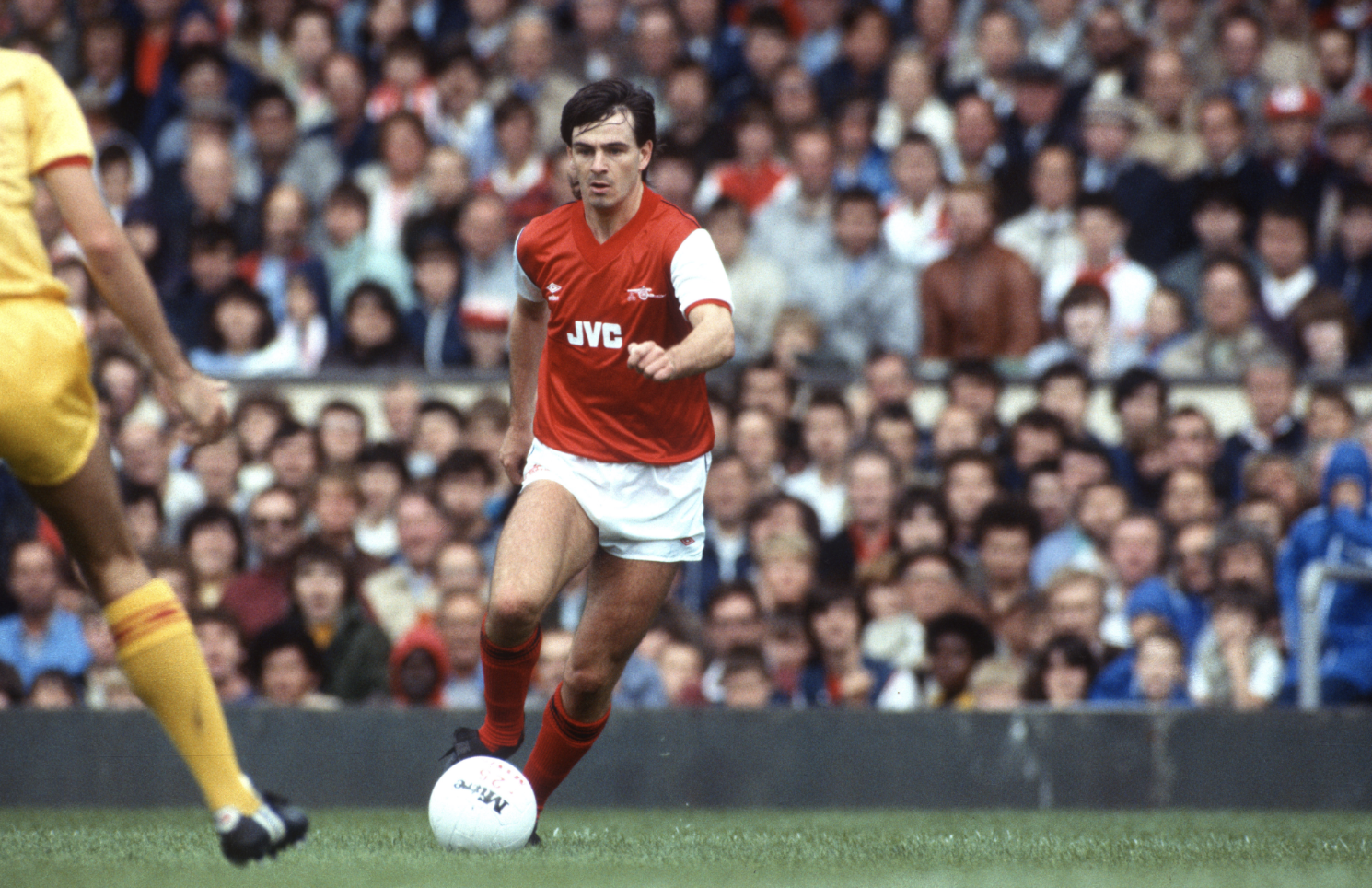
Gooners couldn’t help but love Charlie Nicholas play for The Arsenal
Here's author Colin Whelan with his nostalgia-laden feature piece on Charlie Nicholas: ‘Charles de Goals’, the everyman.
“He should have gone to Liverpool, or stayed at Celtic” – basically, what every football fan in England and Scotland said in 1988
There are various accounts of how it all went wrong for Charlie Nicholas, after he left Celtic at the age of 21, in 1983. And these accounts will vary, according to the version you listen to. What everyone can agree on – Charlie included - is that for the sake of his football career, Charlie Nicholas should never have joined Arsenal in 1983.
The guy was an absolute phenomenon in Scotland.
He had scored 28 goals in his breakthrough season, 1980-81, as Celtic won the Scottish Premiership - Scottish football and Celtic appeared as though it had found its successor to the recently-departed Kenny Dalglish. However, an adjustment to life under the limelight and a loss of form in his second season, preceded Charlie breaking his leg in a friendly against Morton in January 1982 – cue the end of that season.
That was plenty for a young man take in.
Feted by everyone, his goals had clinched his team the title the previous season, and he’d only just turned 19. There were realistic prospects Charlie of going to the World Cup with his national team at the end of the next season, but the loss of form and leg break had wrecked everything.
Questions were now being asked, as to what would happen next and whether Charlie Nicholas would recover his very best form.
However, a refreshed, recuperated and a fully recovered Nicholas answered those questions in the very best way possible in the 1982-83 season, by knocking in 48 goals and winning all the personal awards going.
What a comeback, and at the age of 21 we all thought we were watching Scotland’s next great player.
He even looked like Scotland’s actual best player back then, terrorising a league that bears no resemblance to what it is now. Back in 1983, Aberdeen won a Cup Winners Cup Final against Real Madrid – Alex Ferguson was at the height of his powers as a manager in Scotland. Back in 1983, despite all of Nicholas’ goals, Celtic were beaten to the title by Dundee United, who would go on to contest a European Cup semi-final the next season. And back in 1983, you would have said that he was better than Dalglish at 21 – that’s how good a player Charlie Nicholas was. And he always scored against Rangers!
But as this huge world of opportunity opened up for him, an equally huge world of dilemmas presented themselves to Charlie. To Billy McNeill his manager, and for the board at Celtic Football Club. The club claimed they were desperate to keep him – whilst secretly listening to offers for their soon-to-be-out-of-contract talisman.
Liverpool, Man United and Arsenal were all in the mix to sign him. Charlie had his choice of the top two teams in the country, but still chose Arsenal. He does now regret his time there, but it broke the poor guy’s heart to leave them in 1988. That’s what Arsenal still means to Charlie.
Nicholas says that the initial attraction to Arsenal in 1983 was Don Howe, and the way he constantly spoke of ‘The Arsenal’ to him.
Charlie was soon wrapped up in the history of the club, and he “loved the red shirts with the white sleeves, too”.
There were also promises of making other big signings, like Liam Brady. And there was also the small matter of a £100,000 signing-on fee and £2,000 a week, to ultimately persuade him to sign for a team that had finished 10th in Division One, the previous season. That, and the luminescence of London, were enough to draw the sting away from his rejection of Liverpool.
From that point, Charlie developed from a ‘goal-a-game’ unplayable striker at Celtic, to a ‘goal-every-four-games-Jock-misfit’ at Arsenal.
Charlie himself said that he missed the ‘father figure’ he had at Celtic, in the shape of Danny McGrain. The older players in the Arsenal squad all lived 20 miles away from the club, and Charlie found himself a little restless.
The 21-year-old down from Glasgow, who looked like Jim Kerr, and Bono, decided to leave his flat - wearing his famed leather trousers - just to see what London might offer him. Cue the cries of “London will swallow him”.
And, so, it did. Not spectacularly. Charlie was never a boozer to challenge the ‘Arsenal Class of the 90s’, but he was often photographed champagne glass in hand, surrounded by a procession of ‘Page-3 Stunners’ and singer/celebrities who could afford a night off, in various London nightclubs.
Those distractions, added to a lack of supporting pastoral infrastructure at Arsenal, meant that Charlie Nicholas was doomed to fail in English football.
The Arsenal Supporters Trust still awarded him with their player of the season honour at the end of his first season in 1983-84.
This, in no small part, as a thank-you to Charlie for bagging a brace at White Hart Lane on Boxing Day, as Arsenal won 4-2. The future looked so bold, after that particular game. And Gooners couldn’t help but love Charlie.
He had to wait four seasons before he won his only honour in English football, a winners’ medal in the 1987 Littlewoods Cup Final.
Charlie scored the two goals that defeated Liverpool that afternoon, having won his desperate battle to get fit for the final. Even then, every non-fan of Arsenal sneered. He scored with a one-and-a-half-yard tap-in and a wildly deflected shot that wrong-footed Grobbelaar.
But by 1988, after a season and half under the tutelage of George Graham, he was back in Scotland, where he stayed for the rest of his career.
First with Aberdeen, and then back to Celtic. He won a League Cup and a SFA Cup with Aberdeen, but nothing more with Celtic. He ended his footballing career with Clyde, retiring for good in 1996.
When we come to assess Charlie Nicholas’ football career, we will conclude that it is a story of unfulfilled talent.
Probably, no one regrets that more than Charlie.
No matter, Charlie still remains a very personable guy, the type of person you would want to spend time with, over a beer (not champagne).
He excelled as a tv pundit, mainly because he has a genuinely warm and engaging personality. And you just know he loves his football.
We fans understand that there is usually a world of difference between the work ethic, talent and aspirational grasp of elite athletes, and the rest of the 99.9% of us poor sods who need to work for a living. We also elevate these athletes, our heroes, to far higher levels. But we also understand that there is also one crucial similarity.
If any one of us office, factory, service or retail wallahs wish to better ourselves - to gain a promotion, to earn more money – we seek to increase our skills and experience. We attend courses, to learn new skills. We engage with new experiences to progress our career. We call this ‘professional development’.
But for many of us, we don’t bother - or we make the wrong choices to progress our careers - we don’t develop professionally. Charlie Nicholas, in 1983, did exactly what most of us do.
You could argue – and Charlie would argue – that his professional development on the football pitch would have been held up at Liverpool, because Rush and Dalglish were in the queue just ahead of him.
OK, so you wouldn’t want the chance to train with those two – and the rest of that team – because you might have to wait a while for your chance?
A loss of form and injuries always play a part in a team’s season, especially, when one half of the pair is nearly 33 and is already being tapped up to take over as manager in the next few years.
Charlie Nicholas was that good at 21, that Liverpool may well have moved an ageing Dalglish into a new role behind a new strike pairing of Rush and Nicholas. That’s what Liverpool had started to do by 1984-85 anyway, with the signings of Paul Walsh and Michael Robinson. And Charlie was a better player than those guys. Sadly, Charlie said no to professional development, Liverpool-style.
The final analysis tells us that Charlie should have taken that chance. We would have loved to have seen a bit more of that utter jubilation in England, Charlie scoring goals and winning trophies. Watching Charlie and his knees, thighs, arms pumping, celebrating a goal for Celtic was joyous – we knew just what it meant to him.
And, Charlie Nicholas, despite the unfulfilled football career, shared his great joy with us. He also showed us he was human, like us, and that he could make wrong decisions, just like us.
And, therein, lies Charlie’s great appeal.
Despite being a wonderful footballer, Charlie Nicholas was also sprinkled with a heavenly dusting of ‘the everyman’.